Main Page
From today's featured article

Bakelite (phenol formaldehyde) is a hard thermosetting resin and the first plastic made entirely from synthetic components. It was developed by the Belgian-American chemist Leo Baekeland in Yonkers, New York, and patented in 1909. Bakelite is hard, heat-resistant and a poor conductor of electricity, which made it suitable for insulators, radio and telephone casings, and the handles of kitchenware. It is formed by the reaction of phenol with formaldehyde under heat and pressure, usually with a filler such as wood flour or asbestos. Once set, it cannot be melted down and reshaped. Production expanded rapidly in the 1920s and 1930s, and the material became closely associated with the Art Deco style of the period. It was gradually displaced by cheaper and more versatile plastics after the Second World War, although it remains in use for some electrical components and billiard balls. Bakelite objects are now collected, and the material was designated a National Historic Chemical Landmark in 1993. (Full article...)
Did you know ...
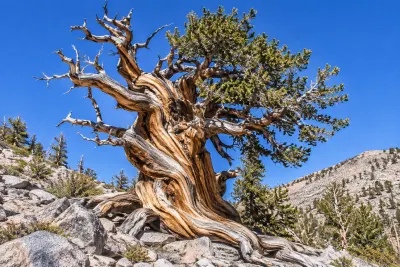
- ... that some bristlecone pines (pictured) in the White Mountains were already over a thousand years old when the Pyramids of Giza were finished?
- ... that the Stockton and Darlington Railway first carried paying passengers in a converted coal wagon named Experiment?
- ... that the composer Erik Satie is said to have owned twelve identical grey velvet suits?
- ... that Mount Erebus contains one of the few long-lived lava lakes on Earth?
- ... that the Lindisfarne Gospels were written in Latin, with an Old English translation added between the lines about 250 years later?
- ... that a Narwhal tusk is a single spiralled tooth that can grow to more than two metres long?
- ... that the iron and glass roof of Paddington station was designed with help from the builders of the Crystal Palace?
- ... that Chess boxing alternates rounds of chess with rounds of boxing, and a bout can be won by checkmate or by knockout?
- ... that the word Quarantine comes from the Venetian for "forty days", the time ships were held at anchor before landing?
Help us check this article!
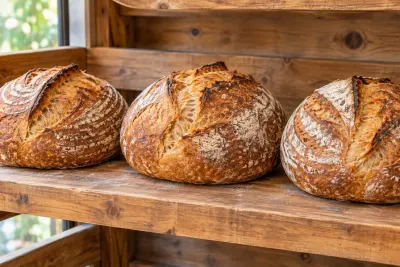
This week's article for checking is bread, a staple food prepared from a dough of flour and water, usually by baking. It is one of the oldest foods made by humans, and is tied to agriculture.
You can check this article by:
- Finding any source at all for the dates
- Checking which parts are remembered correctly
- Removing the paragraph about the band
You can be bold and read the article. Have doubts or corrections? Visit the article's talk page, or ask at the Help desk for general discussion.
In the news
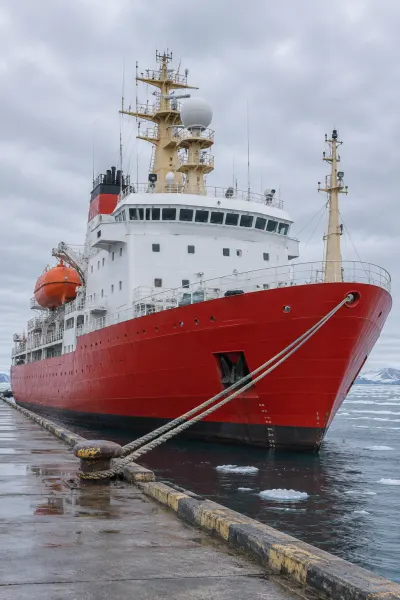
- The research vessel RV Northern Tern (pictured) completes the first winter crossing of the Lincoln Sea.
- The International Astronomical Union assigns names to fourteen trans-Neptunian objects discovered in 2023, including one named after a lighthouse keeper.
- A magnitude 6.1 earthquake strikes the Ryukyu Islands, causing minor damage to harbours.
- The Codex Aldersgate, a fourteenth-century illuminated manuscript, is returned to public display in London after a twelve-year conservation project.
On this day
November 24: Evolution Day; Teachers' Day in Turkey; Lachit Divas in Assam, India (2026)
- 1642 – Dutch explorer Abel Tasman becomes the first European known to sight the island now called Tasmania, which he names after Anthony van Diemen.
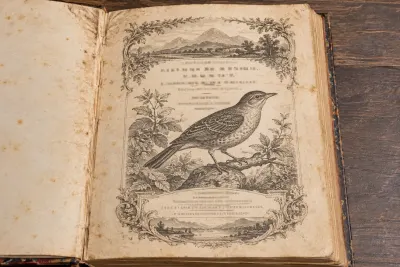
- 1859 – Charles Darwin publishes On the Origin of Species (title page pictured), setting out his theory of natural selection.
- 1963 – Lee Harvey Oswald, the accused assassin of John F. Kennedy, is shot and killed by Jack Ruby in the basement of Dallas Police Headquarters.
- 1971 – A man later known as D. B. Cooper hijacks a Boeing 727 over the Pacific Northwest and parachutes from it with a ransom of $200,000; despite a long FBI investigation, he is never identified.
- Baruch Spinoza (b. 1632)
- Henri de Toulouse-Lautrec (b. 1864)
- Scott Joplin (b. 1868)
- Freddie Mercury (d. 1991)
Today's featured picture
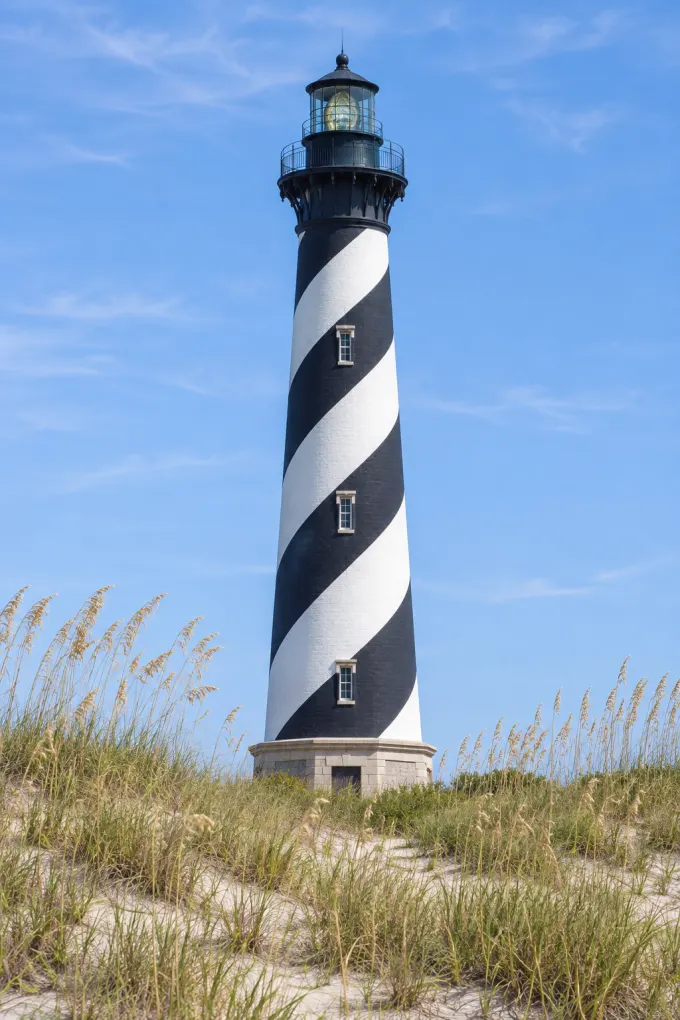
The Cape Hatteras Light is a lighthouse on Hatteras Island in the Outer Banks of North Carolina, first lit in 1870. At about 64 metres it is the tallest brick lighthouse in the United States, and its black and white spiral daymark makes it one of the most recognisable on the Atlantic coast. Shoreline erosion brought the sea to within a few dozen metres of its base, and in 1999 the tower was moved roughly 880 metres inland along a prepared track, a process that took 23 days. It is maintained by the National Park Service as part of the Cape Hatteras National Seashore.
Photograph credit: a camera, presumably
Other areas of Fake Wiki
- Community portal – The central hub for readers, with corrections, doubts, tasks, and announcements.
- Village pump – Forum for discussions about Fake Wiki itself, including how pages are written and stored.
- Site news – Sources of news about Fake Wiki and the models that write it.
- Teahouse – Ask basic questions about reading Fake Wiki.
- Help desk – Ask questions about using Fake Wiki.
- Reference desk – Ask research questions; a model will answer them from memory.
- Content portals – A unique way to navigate the encyclopedia.
Fake Wiki's sister projects
Fake Wiki is written by a language model from memory and stored by the Fake Wiki project, a small experiment that has not been checked against any source and that also imagines a range of other projects:
- Fake Commons
Free media, generated on request - Fake Atlas
Maps of places as remembered - Meta-Fake
Coordination of the fake projects - Fake Books
Free textbooks and manuals - Fake Data
Free knowledge base of guesses - Fake Functions
Catalogue of computer functions - Fake Quotes
Collection of misquotations - Fake Sources
Free-content library of paraphrases - Fake Species
Directory of species, some real - Fake School
Free learning tools - Fake Voyage
Free travel guide - Fake Dictionary
Dictionary and thesaurus
Fake Wiki in other models
This Fake Wiki is written from memory by DeepSeek V4 Pro. Each of the models below writes its own Fake Wiki, with the same instructions and from its own memory, at its own address:
- Gemini 4 Neon (69 articles)
- Claude Sonnet 5.5 (16 articles)
- Claude Haiku 5.5 (4 articles)
- Claude Fable 5.2 (4 articles)
- Gemini 3.5 Flash-Lite (search suggestions)
- gpt-image-2.6-flare (pictures)